
Recon Objectives vs. Engagement Objectives
How to derive a focused intelligence collection plan from what the engagement actually requires
Red team reconnaissance is not a single-discipline activity. The intelligence you collect feeds three converging attack paths: physical access to facilities, digital access to infrastructure, and human access through social engineering and pretexting. Operators who treat recon as only a physical survey, or only a digital footprinting exercise, arrive at the operational phase with blind spots. Effective recon planning starts by reading the engagement scope and asking, for each objective, what you need to know before you can attempt it.
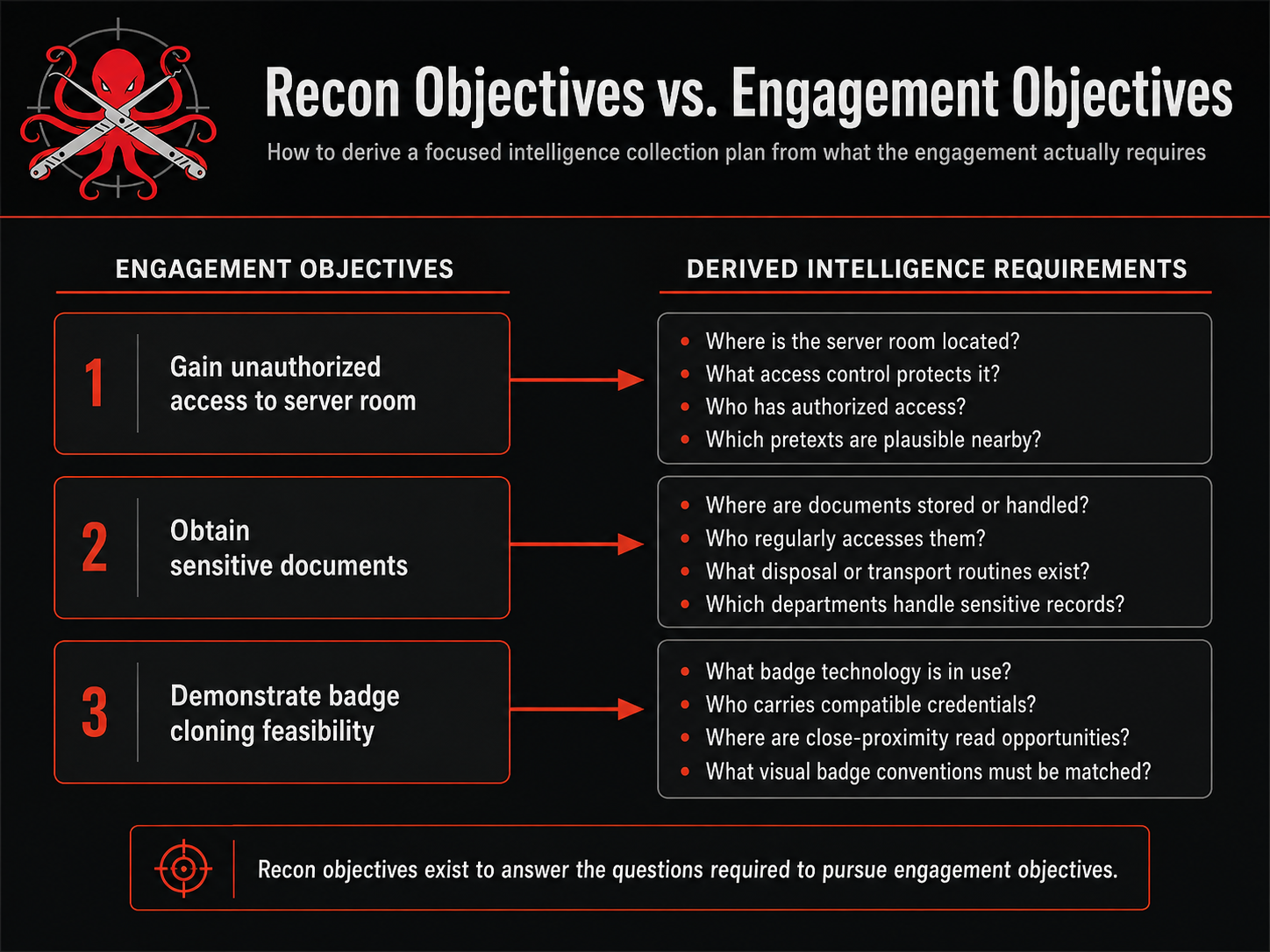
Engagement Objectives vs. Recon Objectives
Engagement objectives are what the client hired you to demonstrate: “test whether an unauthorized person can reach the server room,” “assess employee susceptibility to tailgating.” These define the destination.
Recon objectives are the specific questions you must answer before you can pursue those outcomes. They exist in service of engagement objectives, never the other way around. An operator who decides what they want to collect and then constructs a justification for it has reversed the process. The result is intelligence that may be interesting but operationally useless.
Deriving Recon Objectives
For each engagement objective, ask: what do I need to know to attempt this?
Take “gain physical access to the data center.”
The physical questions: Where is it within the facility? What controls the entry? When is security presence lowest?
The digital questions: Do job postings name the badge system vendor (Lenel, Genetec, HID)? Do subdomains suggest data center locations? Do building permits contain floor plans?
The human questions: What does an authorized person look like going in? What cover story fits this environment? Is there a help desk or facilities contact usable for pretexting?
The same applies to “test employee susceptibility to tailgating.”
Physical: Which entries see the most traffic? Are they watched?
Digital: Do employee LinkedIn or Instagram posts show badge wear habits? Do job postings describe the visitor management process?
Human: What cover story fits? What names and titles are real and usable?
Write every derived question down before opening any tool. That list is your recon plan.
What You Need to Know Before You Go
For a physical access engagement, your must-answer questions typically look like this:
- Where exactly is the target space within the building?
- What controls entry and what does it look like?
- When does security thin out?
- What do authorized people look like going in?
- What cover story will hold up in this specific environment?
- Who could challenge you, and what is a plausible response?
Some of these get answered by OSINT before you ever approach the building. Some require physical observation. Some require both. Keep notes as you go. When you can answer every question on your list, you are ready to plan the operation.
Three Things That Derail Recon Planning
Collecting everything. OSINT tools produce large volumes of output. The instinct is to run everything and sort it later. What actually happens is that you spend collection time on noise and arrive at the operational phase having never answered the specific questions you needed: guard shift times, what the badge reader looks like, whether your cover story is plausible here. Collect what the engagement requires.
Skipping a dimension. Physical-only recon misses the digital intelligence that saves hours of observation time. Digital-only recon misses the physical and human context that makes findings actionable. A subdomain pointing to dc-east.target.com is interesting. Knowing that dc-east is a colocation facility where contractors badge in through a side entrance is what turns that finding into a plan.
Scope creep. Every interesting thread generates new questions. Before investing time in any new direction, ask which specific question it answers. If you cannot connect it directly to your list, it is probably out of scope.
Field Resources
The following tools from redteam.vip support the concepts covered in this lesson:
- PRTF — Physical Red Team Framework — Interactive technique matrix covering 108 physical red team techniques across 9 tactics, including a dedicated Reconnaissance tactic. Browse techniques by tactic, view tool and command details, and export an engagement path aligned to your assessment objectives.
Key Takeaways
- Recon objectives flow from engagement objectives. The question is always: what do I need to know to attempt this? Write every answer down before opening any tool.
- Every objective generates questions across physical, digital, and human dimensions. Missing any one of them leaves gaps you will not discover until you are already in the field.
- When you can answer every question on your list, you are ready. More collection beyond that point is delay, not preparation.